
A few well‑chosen items cover almost everything most families need. They do not have to be fancy, but they should be safe, comfortable, and easy to use for both adults and children.
Key tools include:
- Treat pouch for fast access to rewards
- Training treats in different values (kibble for easy tasks, chicken or cheese for harder ones)
- Standard flat lead around 1.5–2 metres long
- Well‑fitted collar or front‑clip harness
- Clicker or whistle as a clear marker (optional)
- Crate or firm dog bed in a quiet spot
- One or two special toys saved only for training
A treat pouch is one of the most helpful tools. It clips to a belt or waistband and holds lots of tiny treats, so rewards are always close at hand during walks or housework. Many people use small pieces of the dog’s normal food for easy tasks, and keep softer, tastier pieces such as cooked chicken for harder skills like recall past another dog.
A standard flat lead gives much better control than a retractable lead, which can cause burns and tangles and often teaches dogs to pull. A well‑fitted collar or harness keeps the dog safe without rubbing or choking. The two‑finger rule helps here: adults should be able to slide two fingers between the strap and the dog’s body. For dogs that pull, a front‑clip harness often works better and kinder than a collar.
Some families like to use a clicker or whistle as a clear marker sound. These tools are optional, but they can help to time rewards perfectly. A crate or firm dog bed placed in a quiet corner gives the dog somewhere to rest and plays a big part in house training. Finally, one or two special toys kept only for training, such as a tug rope or squeaky ball, can act as big rewards for tough tasks.
| Item | Main Purpose | Typical Cost Range (SGD) |
|---|---|---|
| Treat pouch | Fast access to rewards during training | 10–30 |
| Training treats | Motivate and reward desired behaviour | 5–20 per pack |
| Standard flat lead | Safe control on walks | 10–40 |
| Collar or front‑clip harness | Secure attachment point, comfort and safety | 20–60 |
| Clicker or whistle | Clear marker sound for correct behaviour | 5–15 |
| Crate or dog bed | Safe resting area, supports house training | 40–150 |
| Special toy | High‑value play reward for tough tasks | 5–30 |
Creating A Training Friendly Home Environment
The layout of the home shapes how easy training feels for both dog and family. A calm, low‑distraction area makes it far easier for a young or untrained dog to focus. Many families use the kitchen or living room when it is quiet, and save busy times for easier practice like short sits or name games.
Helpful elements of a training‑friendly home include:
- A clear toileting area outside (garden corner or easy‑to‑reach spot near a path)
- A crate or bed in a quiet corner where no one disturbs the dog
- Hazards such as hanging wires, open bins, and shoes moved or blocked off
- Baby gates or indoor pens to limit access to certain rooms
- A treat pot in a central spot and a hook by the door for leads and harnesses
- A simple written command chart where everyone can see it
Dogs explore with their mouths, so removing temptations lowers the chance of mischief. Baby gates and pens are especially helpful during house training or when guests arrive. Keeping treats, leads, and toys in known, easy places makes it simple to grab a quick five‑minute training session whenever a spare moment appears.
The Ten Minute Daily Training Framework For Success
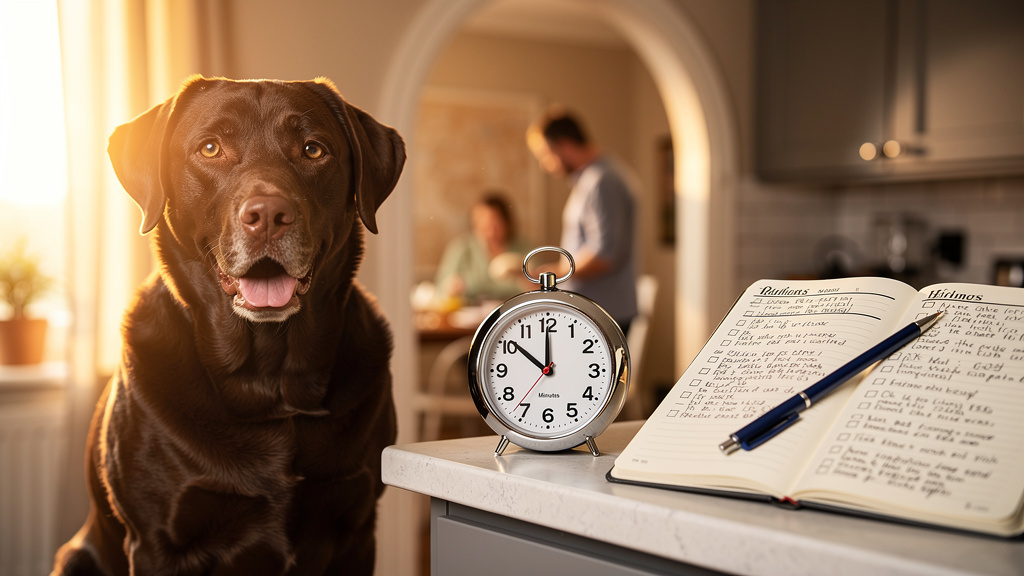
A full obedience class can look scary on a busy calendar, but ten focused minutes at home is realistic even on work and school days. A daily dog training routine built around short practice blocks fits between meals, homework, or screen time. Dogs learn well from repetition and clear patterns, so brief sessions stacked across days and weeks often work better than long, tiring drills.
Short sessions also match how dogs’ minds work. Most dogs, especially puppies and teenagers, can only hold their full focus for a few minutes at a time. Past that point, they get silly, stressed, or distracted. By planning ahead and knowing exactly what to practise before the timer starts, families can get more value from ten minutes than from an unfocused half hour.
Why Short Daily Sessions Work Better Than Long Sporadic Training
Dogs do not learn like machines. Their brains tire and reset, and they remember best when information repeats in small chunks, with studies on the effect of frequency and duration of training sessions demonstrating that shorter, more frequent practice leads to better acquisition and long-term retention. A five‑ to ten‑minute session matches a dog’s natural attention span, especially for puppies whose minds jump quickly from one thing to another. When practice ends while the dog is still eager, they leave wanting more instead of switching off or getting grumpy.
Frequent, short practice also gives the brain time to build strong pathways. Each small win adds another layer, which makes the behaviour more and more automatic. When a family trains for ten minutes most days of the week, the dog keeps skills fresh instead of forgetting between rare long lessons.
People benefit too. Parents and kids can stay patient and upbeat for a short block of time much more easily than for a long one, which keeps the whole process enjoyable.
Leave a Reply